

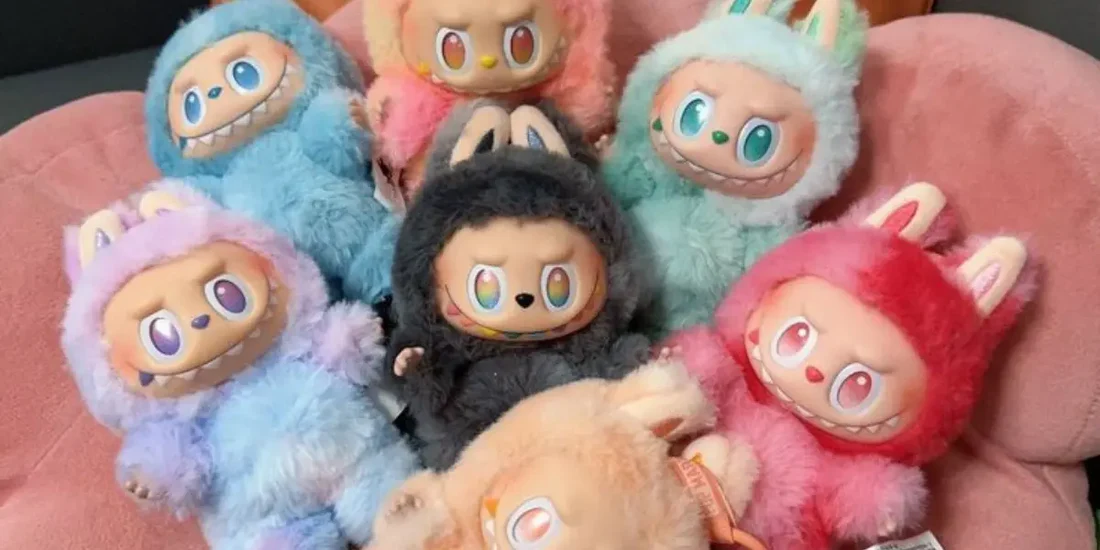
February in Los Angeles has been anything but predictable. Sunshine one day, cold rain the next. In a season marked by uncertainty, Americans, children and adults alike, have been reaching for something small, soft, strange… and strangely comforting.
That something has a name: Labubu.
At first glance, it looks like a mischievous little monster: pointy ears, wide eyes, nine sharp teeth frozen in a grin that is equal parts cute and unsettling. But in living rooms from California to New York, in backpacks, car dashboards, and even luxury handbags, Labubu has become far more than a toy. It has become a phenomenon.
At Toombow Kids, we follow toy trends closely. Very closely. And rarely do we see something ignite this fast.
Parents aren’t just buying Labubu.
They’re searching for it.
They’re calling stores.
They’re refreshing websites.
They’re arguing over the last box.
All for a toy their children are asking for by name.
Not Just a Toy, a Cultural Spark
Created by Hong Kong–born artist Kasing Lung, Labubu first appeared in 2015 as part of The Monsters, a personal artistic universe inspired by European fairy tales and Scandinavian folklore. It wasn’t designed to conquer playgrounds. It was designed to tell a story.
But stories have a way of escaping their pages.
When Chinese retail giant Pop Mart acquired the rights and introduced Labubu into its now-famous blind-box system, something shifted. Mystery met collectibility. Art met chance. Childhood met obsession.
Then came the tipping point:
- A single photo.
- A celebrity bag charm.
- A viral moment.
Suddenly, Labubu wasn’t just known in underground art-toy circles. It was everywhere.
Why America Fell in Love
In the United States, Labubu landed at exactly the right moment.
Psychologists often talk about “transitional objects,” items that provide emotional comfort during periods of stress or change. Labubu, with its fuzzy body and devilish smile, seems to speak directly to that need.
- It’s not perfectly cute.
- It’s not perfectly scary.
- It lives in between.
Children : see a playful companion.
Adults : see nostalgia.
Collectors : see rarity.
And parents? Parents : see something that makes their kids smile.
That’s powerful.
A Toy That Refuses to Grow Up, And That’s the Point
One of the most fascinating aspects of Labubu is this: officially, it isn’t even marketed as a children’s toy. Many versions are labeled 15+. It’s sold as a collectible, a keychain, a design object.
And yet, children want it desperately.
Because Labubu doesn’t talk down to them.
It doesn’t explain itself.
It invites imagination.
In an era of hyper-digital toys, Labubu is silent. Still. Tangible. It asks nothing, except to be held.
The Scarcity Effect
More than 300 versions exist. Some cost $15. Others have sold for hundreds of thousands of dollars at auction. Limited editions vanish in minutes. Websites crash. Counterfeits flood the market.
- Scarcity fuels desire.
- Desire fuels conversation.
- Conversation fuels virality.
And suddenly, a small monster with pointy ears becomes headline-worthy.
The Toombow Kids Take
At Toombow Kids, we believe toys matter. Not because of their price. Not because of their hype. But because of what they unlock.
Labubu unlocks imagination.
It unlocks emotional expression.
It unlocks the right, at any age, to keep a piece of childhood close.
In a world that keeps telling children to grow up faster, Labubu quietly whispers the opposite:
It’s okay to stay playful.
And perhaps that is why this toy isn’t just exploding. It’s resonating.
Labubu isn’t the toy of the moment.
It’s the comfort creature of a generation.
And if February has taught us anything, it’s this:
sometimes, love comes with sharp teeth, and a very soft heart.
